Born: June 23, 1937
Died: August 2, 1985
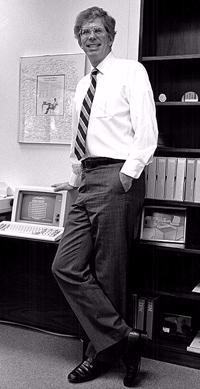
Philip Don Estridge led the development of the original IBM personal computer, and is now known as the “father of the IBM PC.” His decisions helped drastically increase the sales of personal computers and also created an entire industry based on the manufacturing of hardware for IBM PCs. In 1999, the CIO magazine identified him as one of the people who “invented the enterprise” of personal computers, truly cementing his place in history as one of the pioneers of computing.
In 1955, Estridge graduated from Bishop Kenny High School, and then graduated from the University of Florida in 1959. He earned a bachelor’s degree in electrical engineering during his time at this university. Later, he worked in the Army, designing radar using computers. He then moved to IBM where he developed the IBM PC, and then to NASA’s Goddard Space Flight Center until 1969.
Died: August 2, 1985
Philip Don Estridge led the development of the original IBM personal computer, and is now known as the “father of the IBM PC.” His decisions helped drastically increase the sales of personal computers and also created an entire industry based on the manufacturing of hardware for IBM PCs. In 1999, the CIO magazine identified him as one of the people who “invented the enterprise” of personal computers, truly cementing his place in history as one of the pioneers of computing.
In 1955, Estridge graduated from Bishop Kenny High School, and then graduated from the University of Florida in 1959. He earned a bachelor’s degree in electrical engineering during his time at this university. Later, he worked in the Army, designing radar using computers. He then moved to IBM where he developed the IBM PC, and then to NASA’s Goddard Space Flight Center until 1969.
Marc Hannah

Born: June 23, 1937
Died: August 2, 1985
Marc Hannah, widely known for his contributions to modern day film special effects, is the co-founder of Silicon Graphics, Inc. (SGI). He founded SGI along with 5 others in 1982, including his professor Jim Clark. SGI specializes in 3D objects, which was revolutionary in the 80s, which won Hannah two awards of Professional Achievement from both the Illinois Institute of Technology and the National Technical Association. SGI reached $1.1 billion in late 1993, and nowadays, makes 3D animation more accessible to individuals and smaller companies.
Hannah’s education at the Illinois Institute of Technology was made possible by a scholarship from Bell Laboratories, a division of AT&T. Hannah graduated from electrical engineering with a B.S. in 1977. He then continued on to Stanford University, where he earned an M.S. in 1978 and a Ph.D. in 1985. It was at Stanford where he met Jim Clark, whom he founded SGI with. Clark had previously worked on 3D images, which interested Hannah.
Born: June 23, 1937
Died: August 2, 1985
Marc Hannah, widely known for his contributions to modern day film special effects, is the co-founder of Silicon Graphics, Inc. (SGI). He founded SGI along with 5 others in 1982, including his professor Jim Clark. SGI specializes in 3D objects, which was revolutionary in the 80s, which won Hannah two awards of Professional Achievement from both the Illinois Institute of Technology and the National Technical Association. SGI reached $1.1 billion in late 1993, and nowadays, makes 3D animation more accessible to individuals and smaller companies.
Hannah’s education at the Illinois Institute of Technology was made possible by a scholarship from Bell Laboratories, a division of AT&T. Hannah graduated from electrical engineering with a B.S. in 1977. He then continued on to Stanford University, where he earned an M.S. in 1978 and a Ph.D. in 1985. It was at Stanford where he met Jim Clark, whom he founded SGI with. Clark had previously worked on 3D images, which interested Hannah.
Died: August 2, 1985
Marc Hannah, widely known for his contributions to modern day film special effects, is the co-founder of Silicon Graphics, Inc. (SGI). He founded SGI along with 5 others in 1982, including his professor Jim Clark. SGI specializes in 3D objects, which was revolutionary in the 80s, which won Hannah two awards of Professional Achievement from both the Illinois Institute of Technology and the National Technical Association. SGI reached $1.1 billion in late 1993, and nowadays, makes 3D animation more accessible to individuals and smaller companies.
Hannah’s education at the Illinois Institute of Technology was made possible by a scholarship from Bell Laboratories, a division of AT&T. Hannah graduated from electrical engineering with a B.S. in 1977. He then continued on to Stanford University, where he earned an M.S. in 1978 and a Ph.D. in 1985. It was at Stanford where he met Jim Clark, whom he founded SGI with. Clark had previously worked on 3D images, which interested Hannah.

Born: November 9, 1913
Died: January 19, 2000
Hedy Lamarr invented frequency hopping, an electronic device that made radio signals not jam as often. It was originally intended for war purposes during the Second World War, but this device developed into being used in modern-day technology in cellular devices. Some of her minor inventions were an upgraded stoplight and a tablet that creates a carbonated drink.
Lamarr was privately tutored from age 4. At age 16 she enrolled in Max Reinhardt’s dramatic school in Berlin, where she pursued a career in acting. In 1938, after fleeing from her home country of Austria, she moved to London. In London, she met a likeminded engineer, and together they came up with frequency hopping in 1942.
Died: January 19, 2000
Hedy Lamarr invented frequency hopping, an electronic device that made radio signals not jam as often. It was originally intended for war purposes during the Second World War, but this device developed into being used in modern-day technology in cellular devices. Some of her minor inventions were an upgraded stoplight and a tablet that creates a carbonated drink.
Lamarr was privately tutored from age 4. At age 16 she enrolled in Max Reinhardt’s dramatic school in Berlin, where she pursued a career in acting. In 1938, after fleeing from her home country of Austria, she moved to London. In London, she met a likeminded engineer, and together they came up with frequency hopping in 1942.